Generative AI with JAX

Wassim Kabalan

2025-10-01

Outline for This Presentation


  • Introduction to Generative AI
    Understand the mathematical meaning of generating data

  • Deep dive into Generative Models
    Explore the different framework and state of the art ways of generative AI

  • JAX eco system
    Learn core JAX transforms (jit, vmap, grad) and Flax tooling

  • Hands on tutorial

    Explore how generative AI can be used for cosmological inference

What is Generative AI?

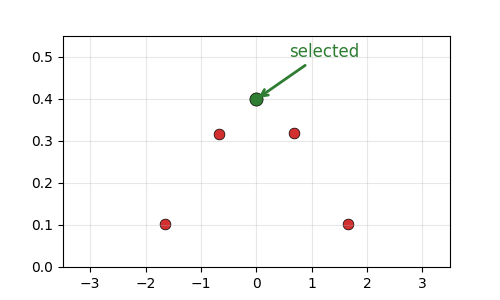
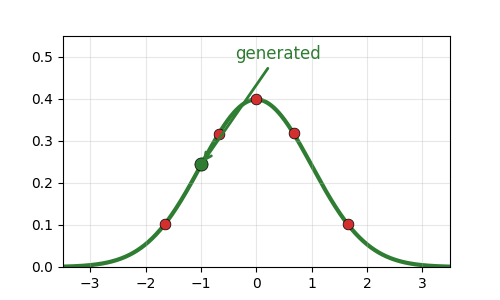
What does “generate” mean?

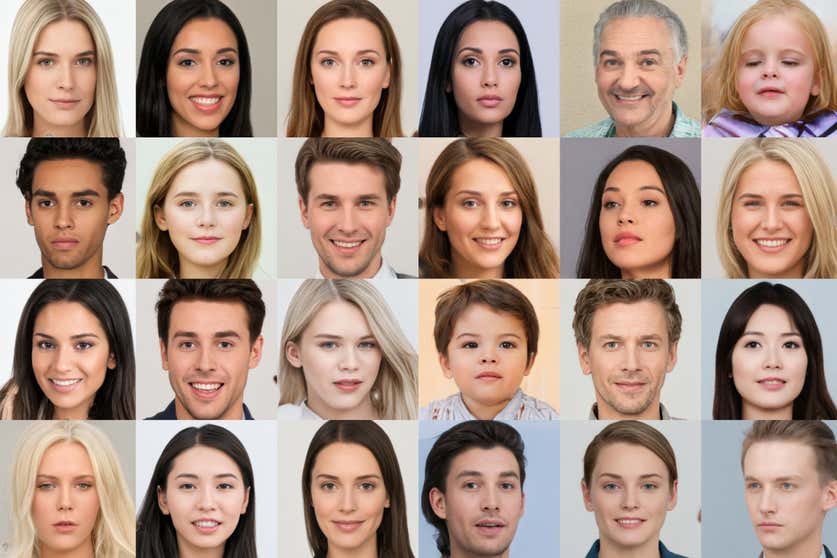
Generated faces example

Key Idea: Generative AI

  • Generative AI is about learning the underlying distribution \(p(\text{data})\) and sampling from it to generate images.
  • The output of a generative model is a new data point.
  • Generative is intrinsically related to probability distributions.

Generative Models

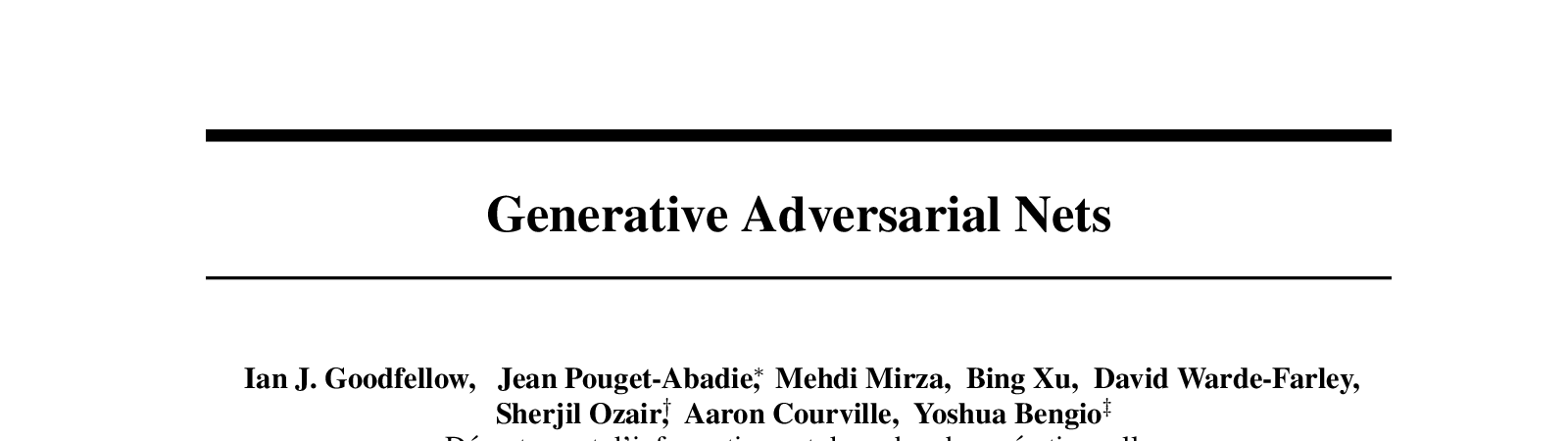
Generative Adversarial Networks (GANs)
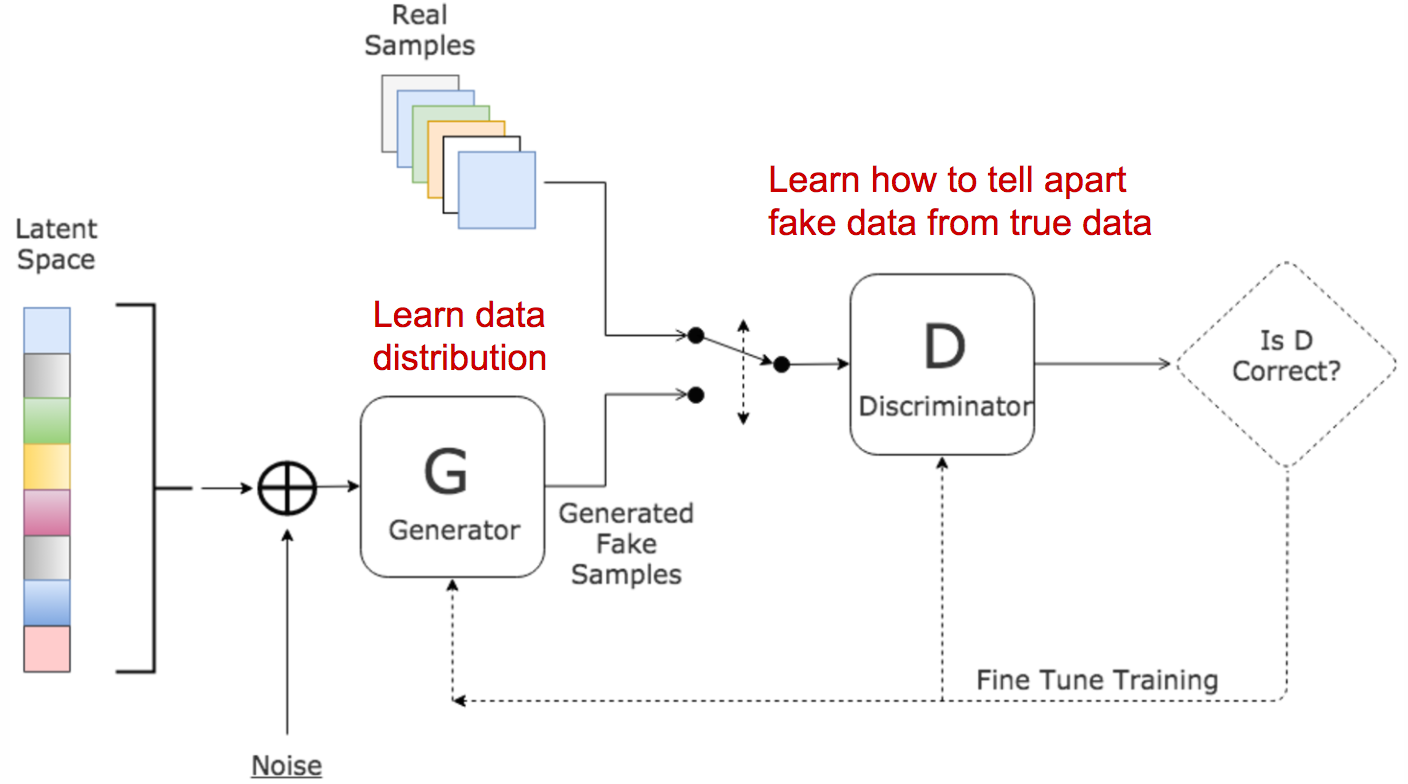


GAN Architecture

\[\min_G \max_D \mathbb{E}_{x\sim p_\text{data}}[\log D(x)] + \mathbb{E}_{z\sim p(z)}[\log(1 - D(G(z)))]\]

  • Loss function
    • Generator: produces samples G(z) to fool D
    • Discriminator: estimates real vs fake probability D(·)

Advantages and Limitations

  • Advantages: sharp samples; flexible implicit modeling; no explicit likelihood.
  • Limitations: unstable training; mode collapse; sensitive to architecture and tricks.

Limitations with GANs

Unstable learning
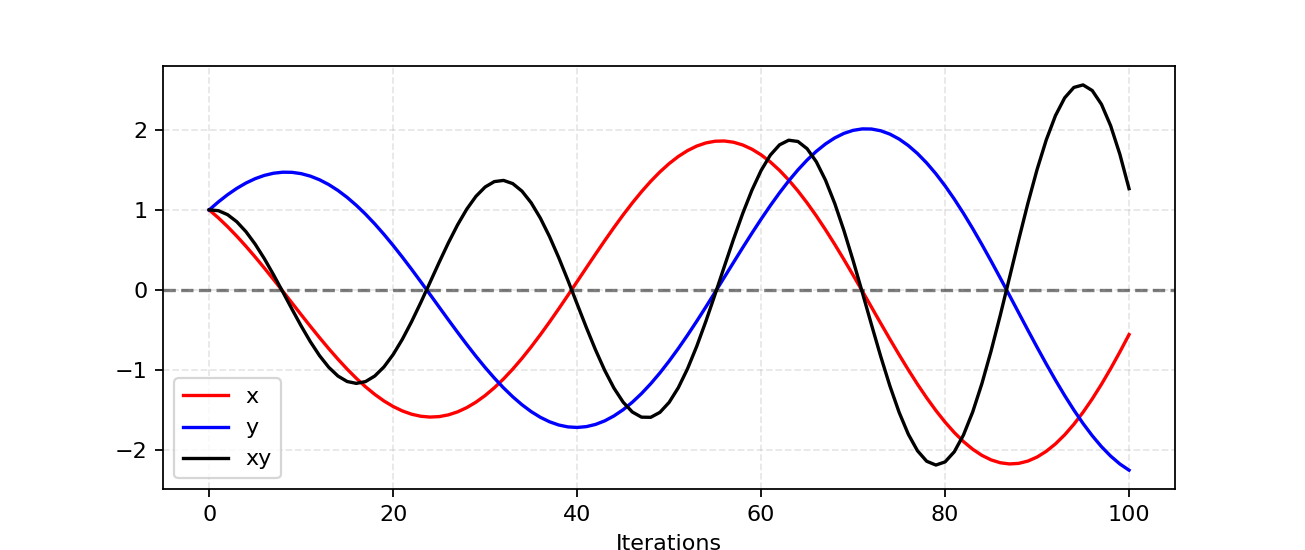
Nash equilibrium illustration

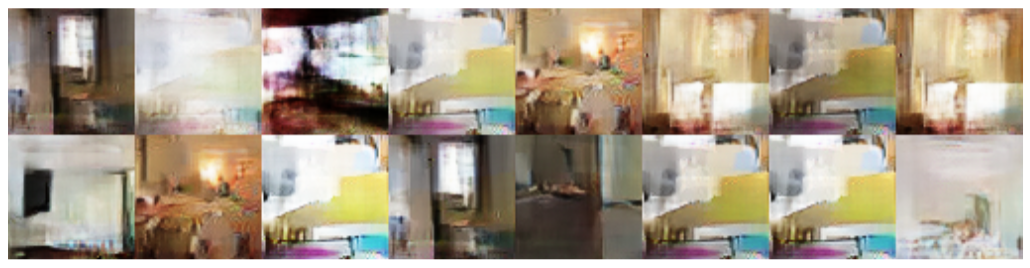
Mode collapse

Mode collapse

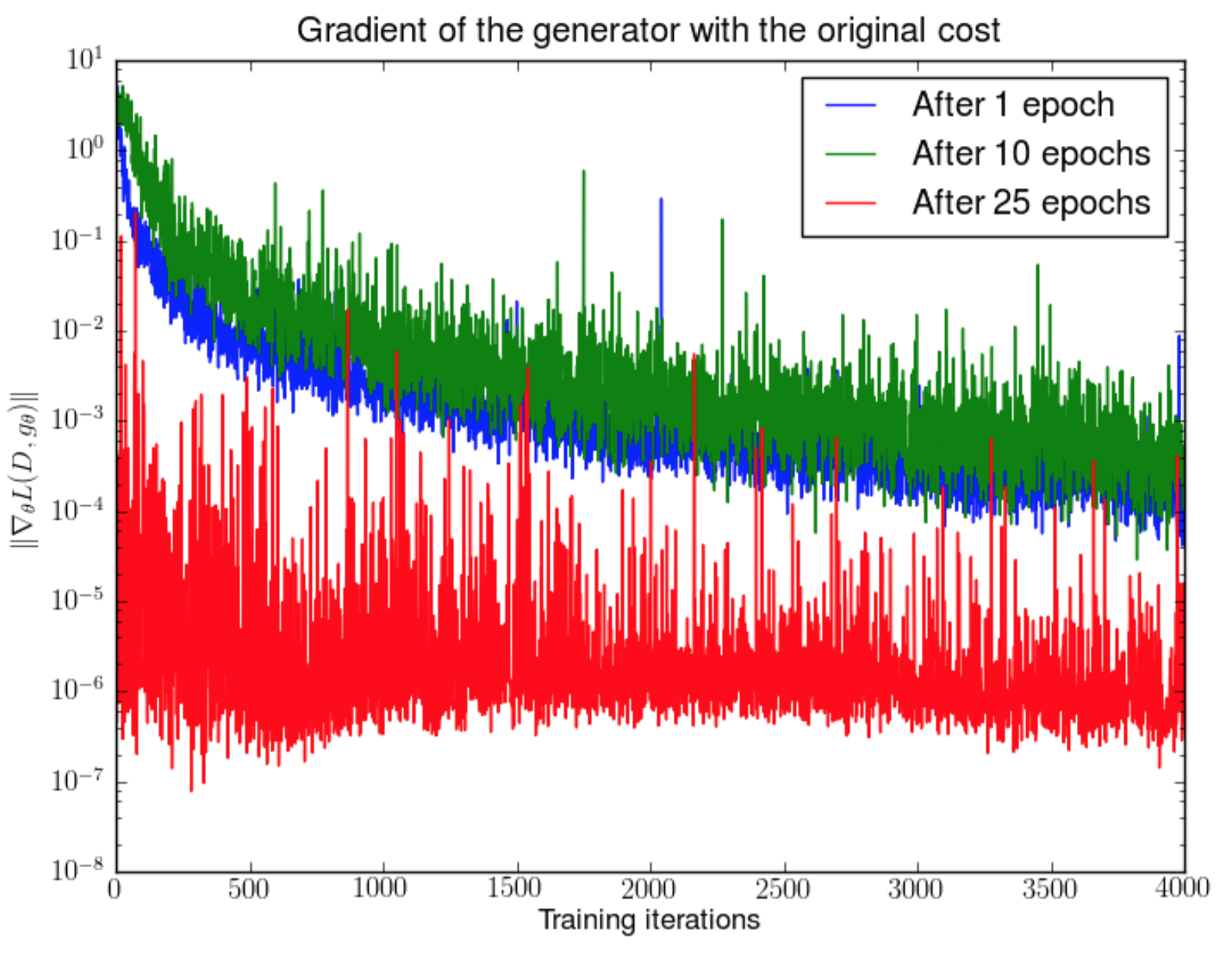
Vanishing gradients

Vanishing gradients

Some possible solutions

  • Use WGAN for more stable training and stronger gradients.
  • Add gradient penalty (WGAN-GP) to keep the critic smooth.

Variational Autoencoders (VAEs)
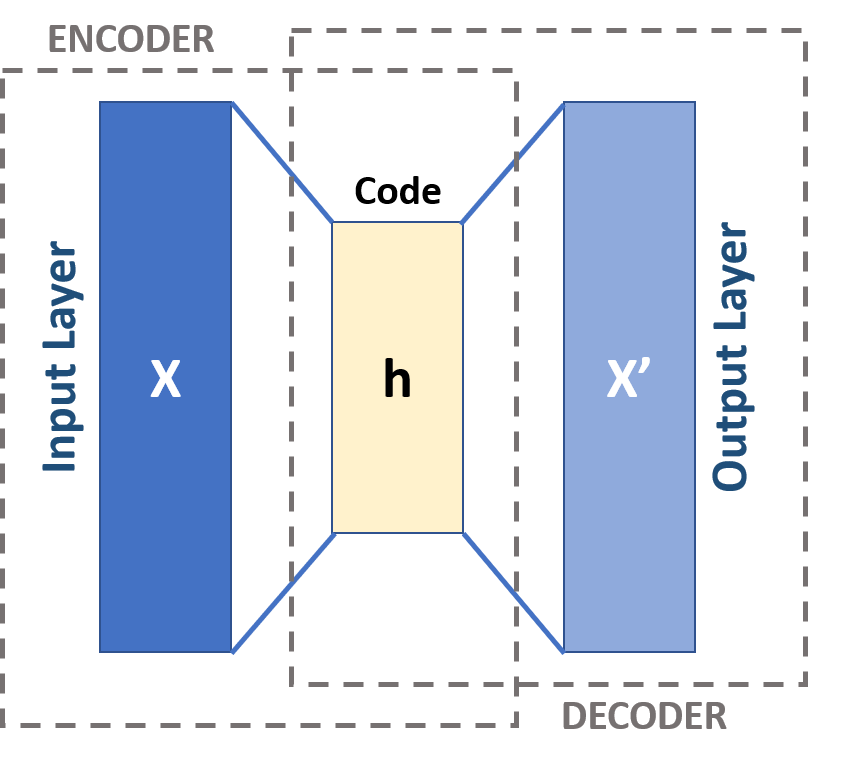
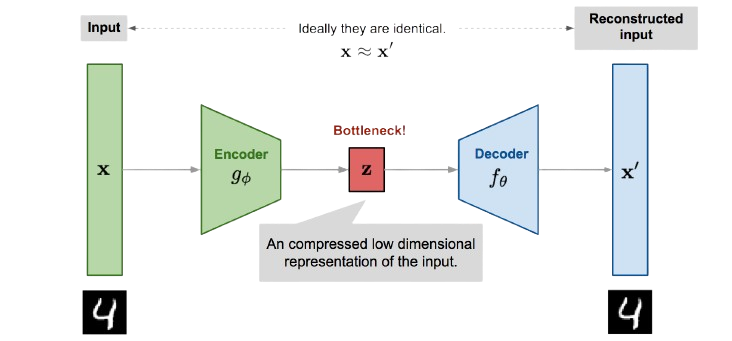
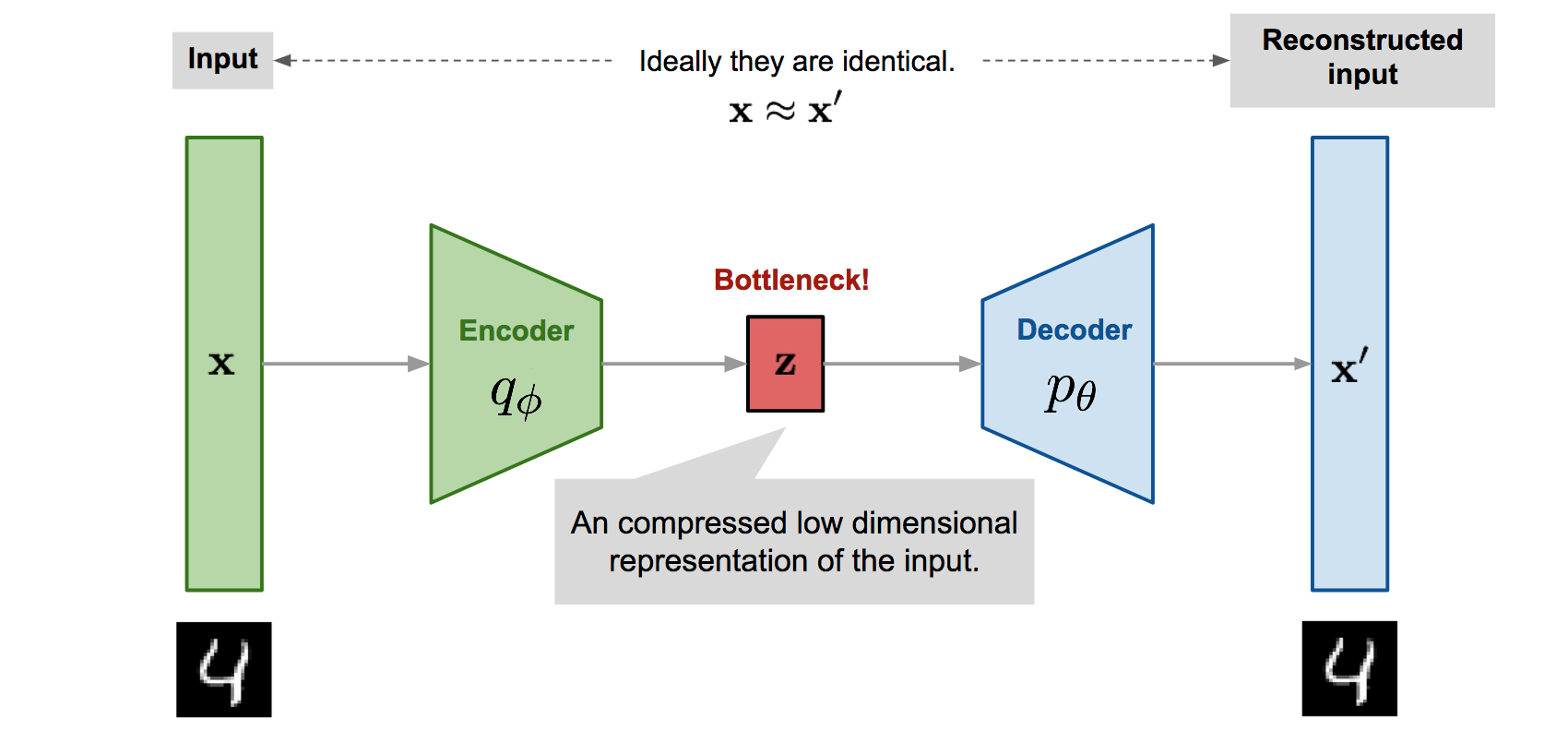
Autoencoder architecture

VAE architecture

VAE takeaways

  • VAE learn optimal compression into the latent space
  • Represents a dataset by an easy to sample gaussian distribution
  • Compared to GAN gives a better access to probability distribution
  • Produces blurrier images than GANs

VAE paper title

Evidence Lower Bound (ELBO):

\[\mathcal{L} = \mathbb{E}_{q_\phi(z|x)}[\log p_\theta(x|z)] - \text{KL}(q_\phi(z|x)\|p(z))\]

  • Reconstruction: decoder quality
  • KL Divergence: latent regularization

Reparameterization trick: \[z = \mu + \sigma \odot \epsilon, \quad \epsilon \sim \mathcal{N}(0,I)\]

VAE — Why KL matters (β-VAE)

Without KL regularization:
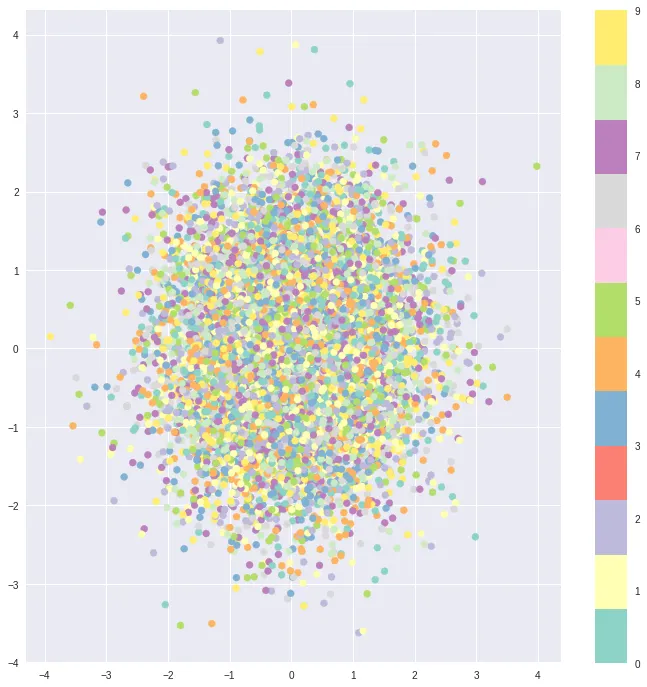
Unregularized

Latent space is unstructured

With KL regularization:
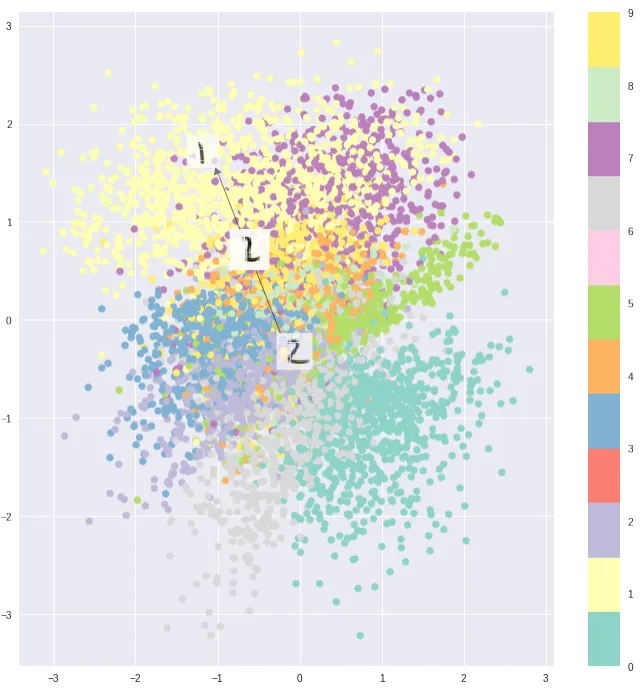
Regularized

Organized, continuous latent space

β-VAE objective:

\[\mathcal{L}_\beta = \mathbb{E}[\log p_\theta(x|z)] - \beta \cdot \text{KL}(q_\phi(z|x)\|p(z))\]

  • \(\beta > 1\): More disentanglement, less reconstruction
  • \(\beta < 1\): Better reconstruction, less structure
  • Limitation: Gaussian prior can bias toward simpler shapes

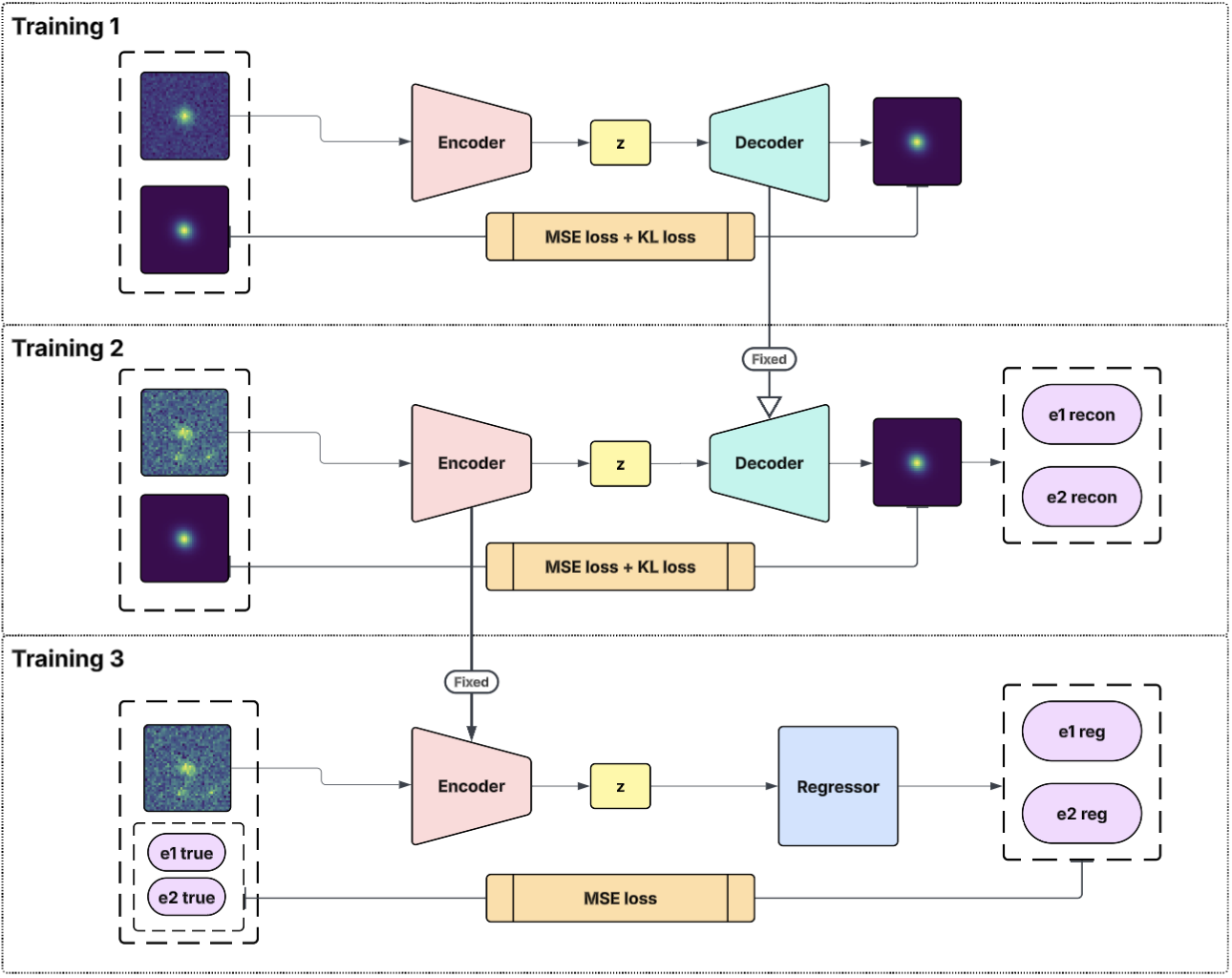
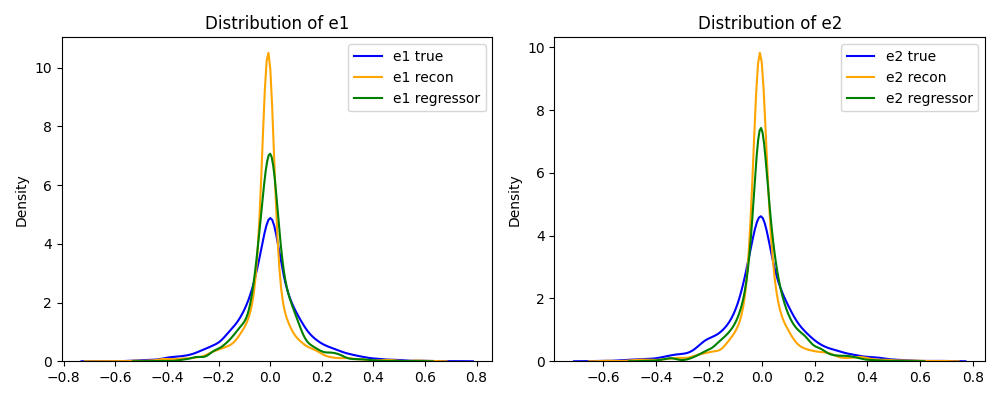
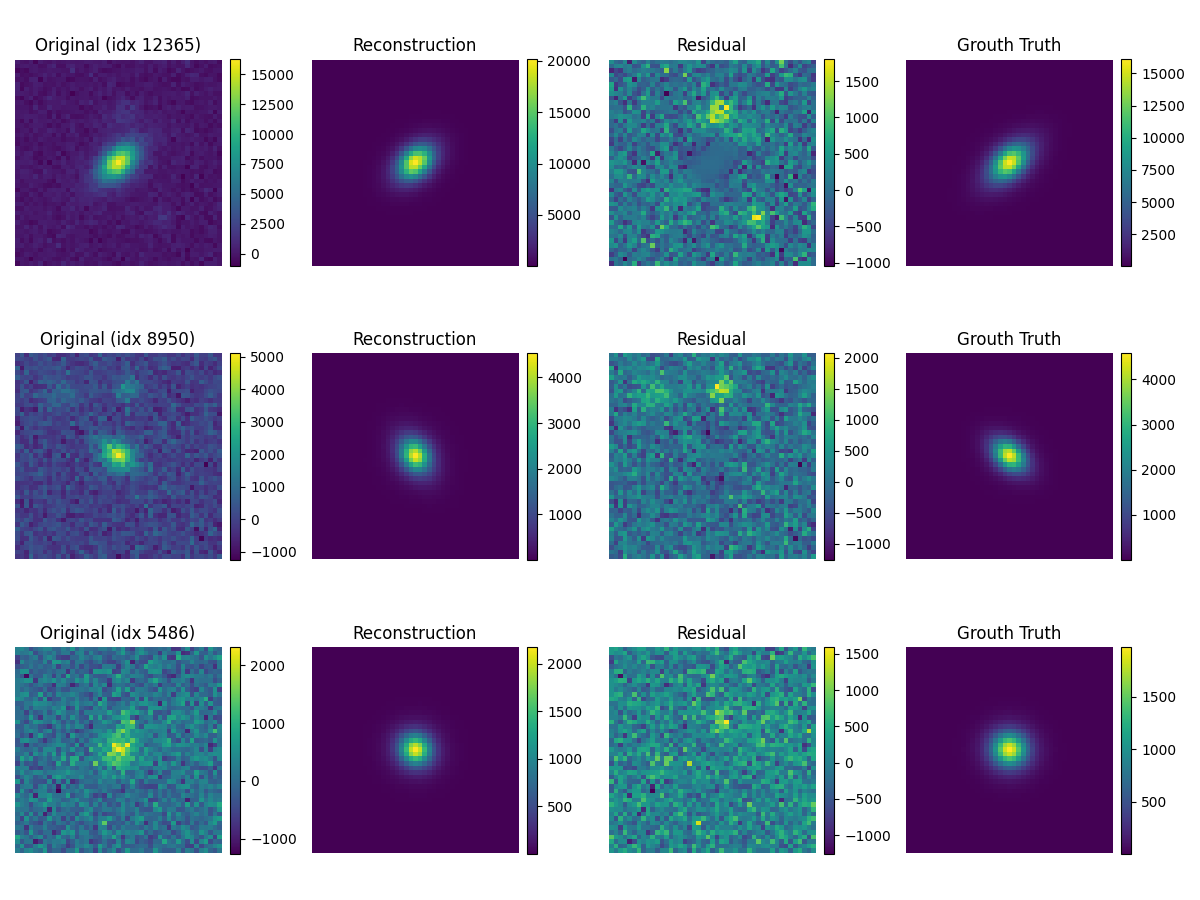
VAE in Cosmology (Deblending)

Binh Nguyen

Deblender architecture

Distribution e1/e2

Reconstructions

Normalizing Flows (Flow-based Generative Models)
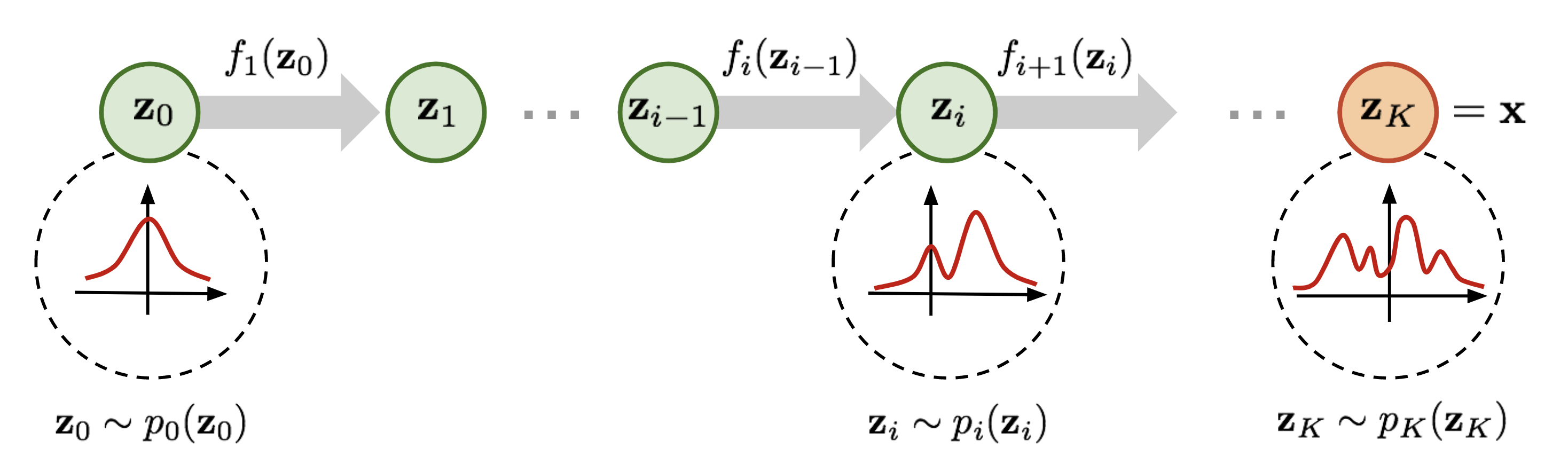
Flow intuition (© Lilian Weng, Lil’Log)

Mappings: \(f(x) \to y\), \(g(y) = z\); \(z = g_{\theta}(x) = g_K \circ \cdots \circ g_1(x)\)

Log-likelihood

\[\log p_{\theta}(x) = \log p_Z\big(g_{\theta}(x)\big) + \sum_{k=1}^{K} \log \left|\det J_{g_k}\right|\]
Rezende & Mohamed (2015)

In short

  • Gaussianize data: \(z = g_{\theta}(x) \approx \mathcal{N}(0, I)\).
  • Exact likelihood: \(\log p_{\theta}(x) = \log p_Z(z) + \sum_k \log|\det J_{g_k}|\).
  • Generate via inverse: \(x = f_{\theta}(z)\), \(z \sim p_Z\).

Coupling Layers : Forward vs Inverse
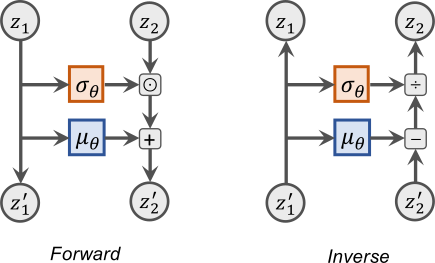
Coupling layer computation graph

Forward (x → y)

  1. Split \(x=(x_a, x_b)\) by mask.
  2. Conditioning network on kept half: \((s, t) = \text{NN}(x_a)\).
  3. Affine update (element-wise):

\[ y_a = x_a, \qquad y_b = x_b \odot e^{s(x_a)} + t(x_a). \]

Inverse (y → x)

Given \((y_a, y_b)\):

  1. Recompute \((s, t) = \text{NN}(y_a)\).
  2. Invert the affine on the transformed half:

\[ x_a = y_a, \qquad x_b = \big(y_b - t(y_a)\big) \odot e^{-s(y_a)}. \]

Masked Autoregressive Flow (MAF) vs Inverse Autoregressive Flow (IAF)
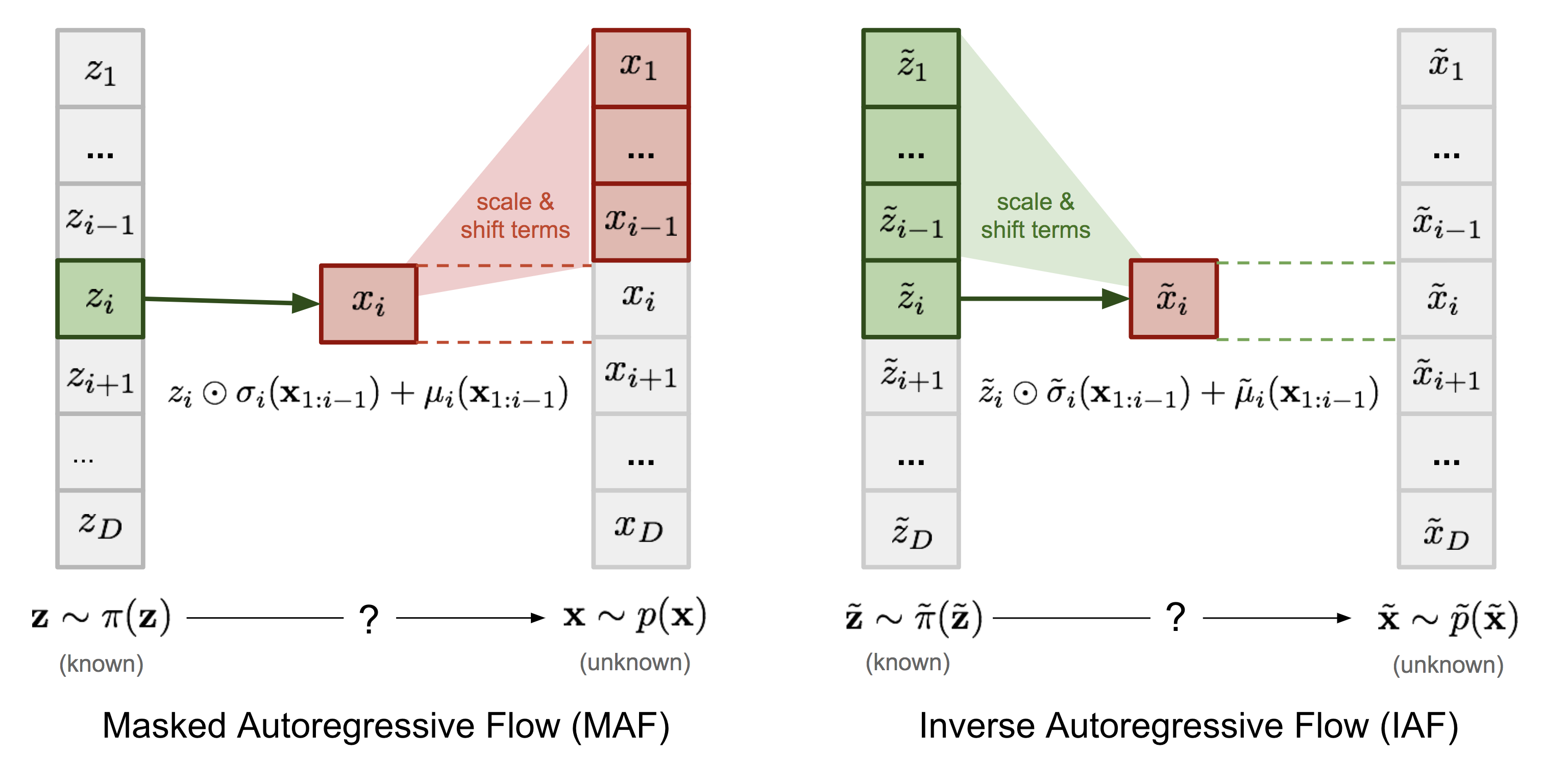
MAF vs IAF comparison

MAF (Masked Autoregressive Flow)

Autoregressive flow where density evaluation is parallel sampling is sequential.

\[ z_i=\frac{x_i-\mu_i(x_{<i})}{\sigma_i(x_{<i})} \]

IAF (Inverse Autoregressive Flow) — fast sampling

Same masked structure but reversed so sampling is parallel (given \(z\)), density is sequential.

\[ x_i=\mu_i(z_{<i})+\sigma_i(z_{<i})\cdot z_i \]

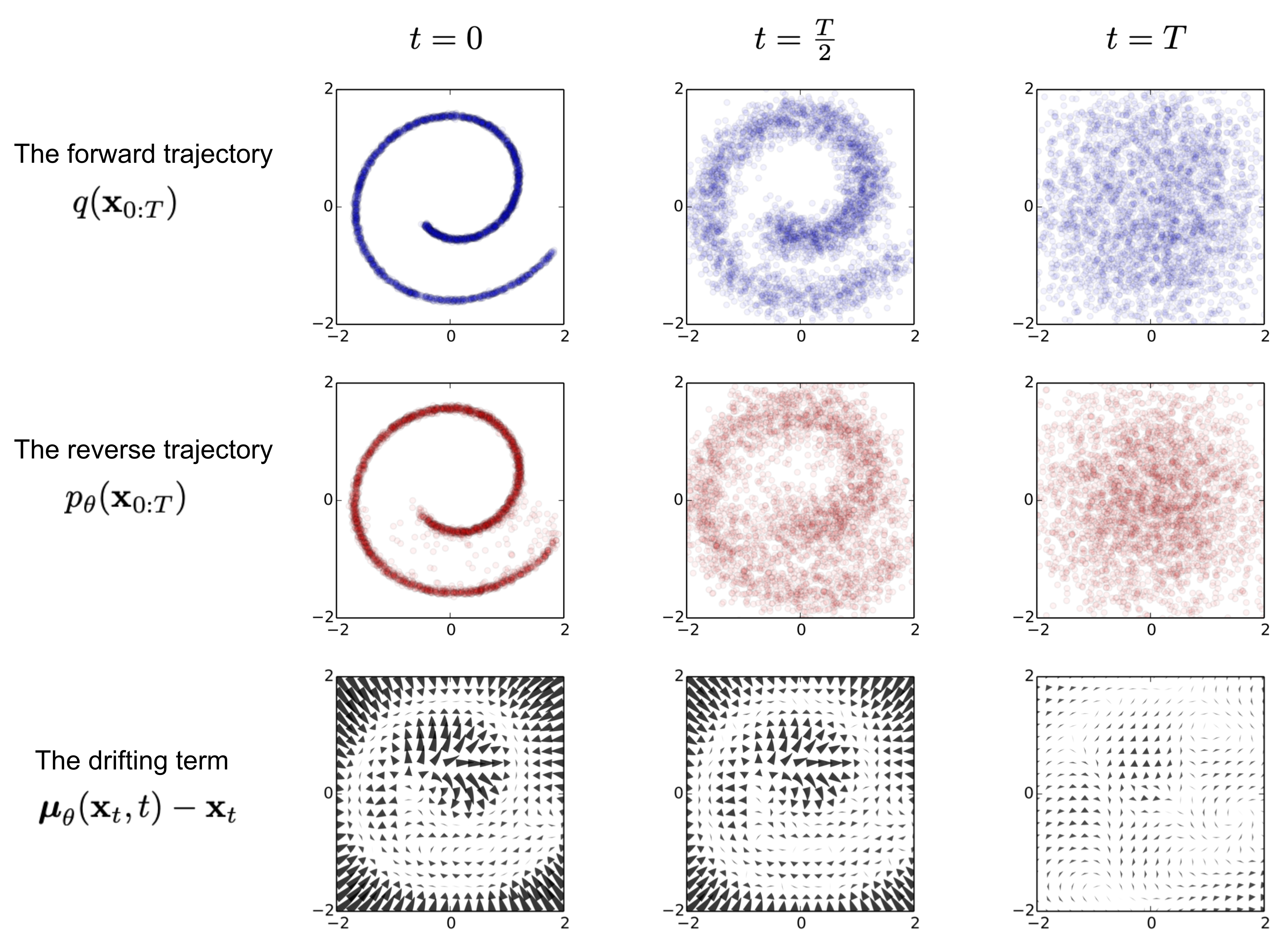
Diffusion Models
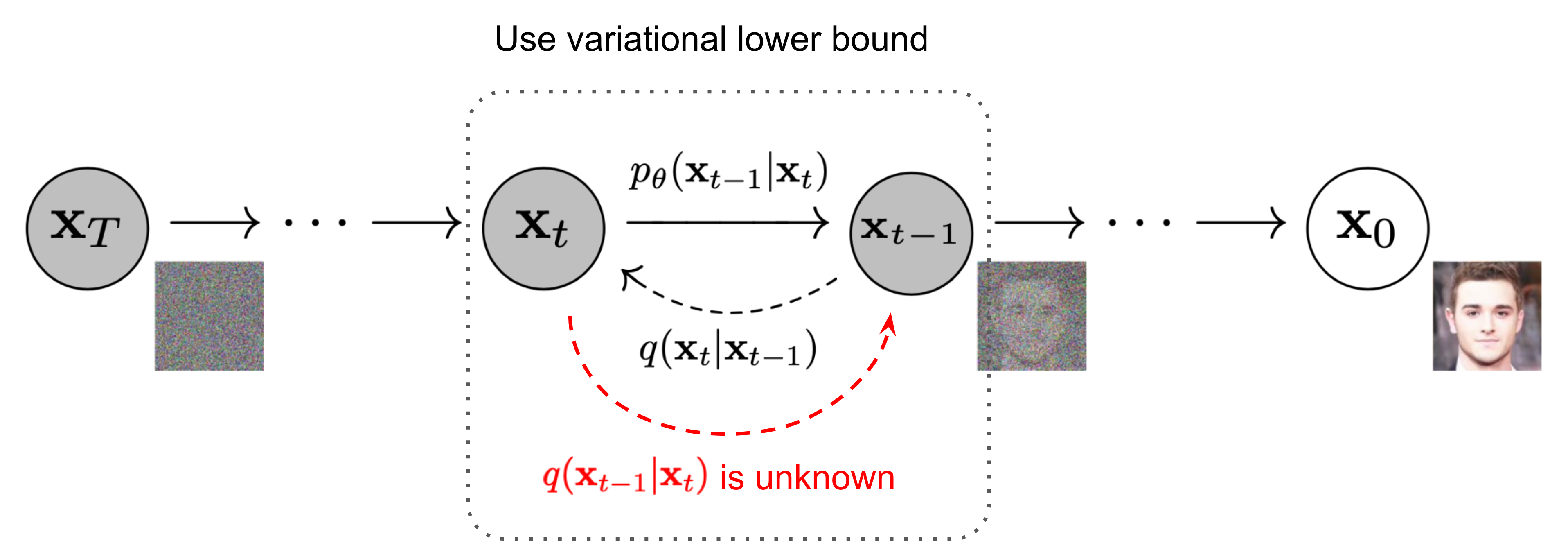
DDPM process

Diffusion visualization

Characteristics of Diffusion Models

Pros:

  • Best quality & coverage: diffusion / flow-matching models for images; rapidly improving for video.

Cons:

  • High computational cost for training and sampling.

Generative models overview
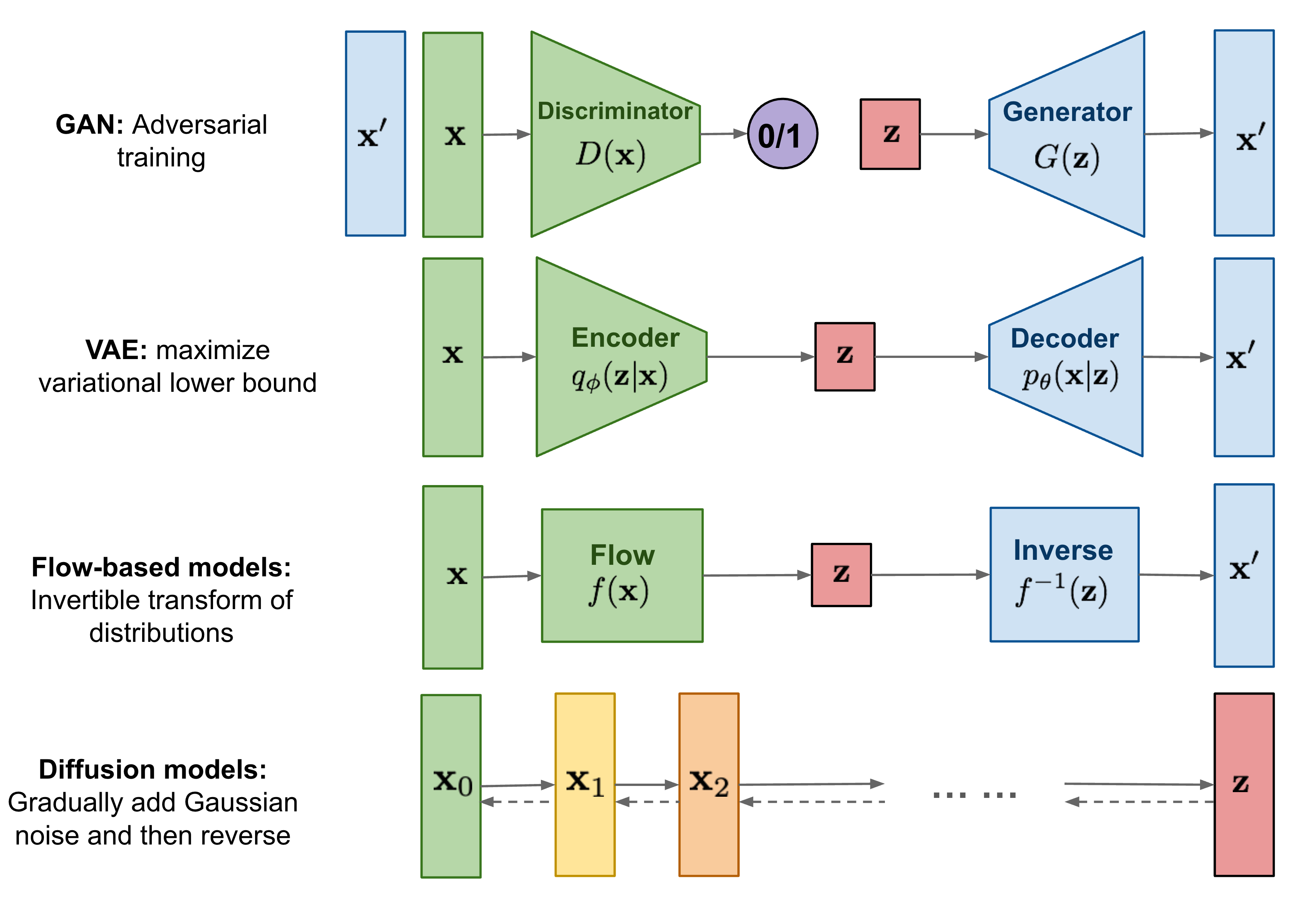
Generative models overview

Model Pros Cons
VAE - Explicit likelihood
- Fast sampling
- Good global structure
- Blurry outputs
- Prior bias (Gaussian)
- Limited expressiveness
GAN - Sharp, high-quality images
- Fast sampling
- Training instability
- Mode collapse
- No likelihood
Flow - Exact likelihood
- Invertible
- Flexible distributions
- Computationally expensive
- Architecture constraints
- Difficult to scale
Diffusion - SOTA quality
- Excellent mode coverage
- Stable training
- Slow sampling (many steps)
- Computationally intensive
- Careful tuning required

JAX Ecosystem

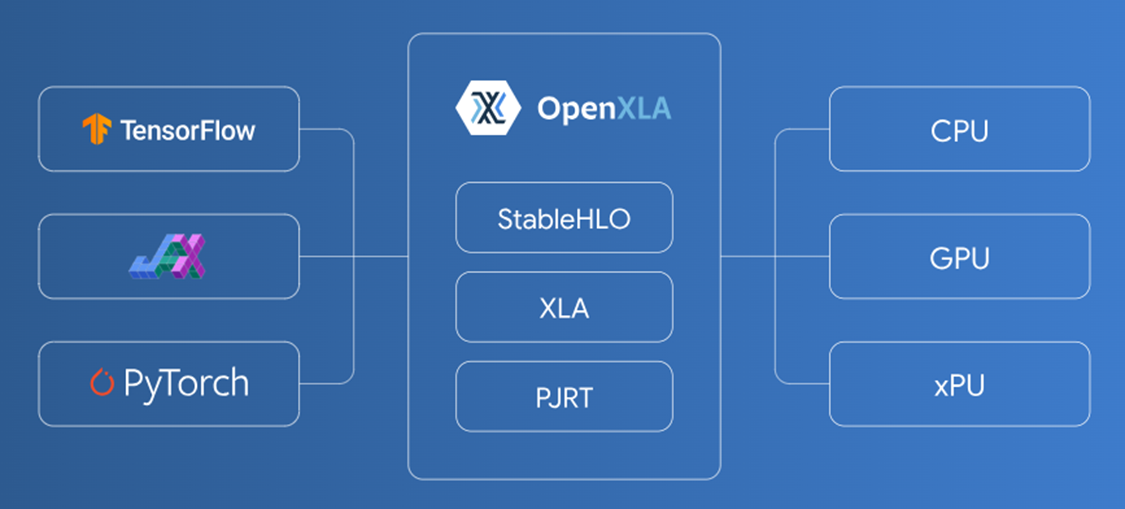
What is JAX?

<h2 style="margin:0;">JAX and OpenXLA</h2>

JAX transforms

JIT (Just in time compilation)

import jax
import jax.numpy as jnp

@jax.jit
def f(x): 
    return jnp.sin(x**2) + jnp.cos(x)

# compiled once, runs fast
y = f(jnp.linspace(0, 3, 1_000))

Auto-vectorization (vmap)

import jax
import jax.numpy as jnp

def score(x, w): 
    return x @ w        # single example

batched_score = jax.vmap(score, in_axes=(0, None))
y = batched_score(X_batch, w)


grad (automatic differentiation)

import jax
import jax.numpy as jnp

def loss(w, x, y):
     return ((x @ w - y)**2).mean()

# grad w.r.t. first arg
dl_dw = jax.grad(loss)(w, x, y)
# 2nd derivative
dl_dl_dw = jax.grad(jax.grad(loss))(w, x, y)
# Hessian matrix
hessian_dw = jax.hessian(loss)(w, x, y)

Multi-device parallelism (shard_map)

import numpy as np
import jax
import jax.numpy as jnp

mesh = jax.sharding.Mesh(np.array(jax.devices()), ('data',))

def double(x):
     return x * 2
     
double_sharded = jax.shard_map(double, mesh=mesh,
        in_specs=jax.sharding.PartitionSpec('data', None),
        out_specs=jax.sharding.PartitionSpec('data', None))

# shard over axis 0
x = jnp.arange(8).reshape(len(jax.devices()), -1) 
y = double_sharded(x)

tiny gradient demo


Computing gradients with PyTorch

import torch
x = torch.randn(10, 5)
w = torch.randn(5, 3, requires_grad=True)

y = x @ w
loss = y.sum()
loss.backward()
print(w.grad)              # gradient lives on tensor state


Computing gradients with JAX

import jax, jax.numpy as jnp

def loss(w, x):
    return (x @ w).sum()

x = jnp.ones((10, 5))
w = jnp.ones((5, 3))
grad_w = jax.grad(loss)(w, x)
print(grad_w)              # returns new array; no hidden state

Implications of functional programming

No impure functions

import jax, jax.numpy as jnp
state = {"counter": 0}

@jax.jit
def bad(x):
    # ❌ side-effect breaks JIT/purity
    state["counter"] += 1
    return x + 1

@jax.jit
def good(x, state):
    # ✅ pure function
    state = {"counter": state["counter"] + 1}  
    return x + 1, state

Explicit PRNG keys

Numpy RNG

import numpy as np
np.random.seed(0)
x = np.random.normal(size=(100,))
y = np.random.uniform(size=(100,))

No inplace mutations

import jax.numpy as jnp
x = jnp.array([1, 2, 3])

@jax.jit
def bad(x):
    x[0] = 10               # ❌ JAX arrays are immutable
    return x

@jax.jit
def good(x):
    x = x.at[0].set(10)     # ✅ returns new array
    return x


JAX RNG

import jax.random as jr
key = jr.PRNGKey(0)
k1 , k2 = jr.split(key)
x = jr.normal(k1, shape=(100,))
y = jr.uniform(k2, shape=(100,))

In general

  • All modified variables must be passed explicitly as function arguments and return values.
  • All arrays are immutable; use .at[].set() or similar to create modified copies.

Neural nets in JAX (Flax)


Defining a CNN model in PyTorch

import torch.nn as nn
import torch.nn.functional as F

class CNN(nn.Module):
    def __init__(self):
        super().__init__()
        self.c1 = nn.Conv2d(3, 32, 3); self.c2 = nn.Conv2d(32, 64, 3)
        self.fc = nn.Linear(64*6*6, 10)
    def forward(self, x):
        x = F.relu(self.c1(x)); x = F.relu(self.c2(x))
        x = x.view(x.size(0), -1); return self.fc(x)

model = CNN()


Defining a CNN model in Flax

import jax, jax.numpy as jnp
import flax.linen as nn

class CNN(nn.Module):
    @nn.compact
    def __call__(self, x):
        x = nn.relu(nn.Conv(32, (3,3))(x))
        x = nn.relu(nn.Conv(64, (3,3))(x))
        x = x.reshape((x.shape[0], -1))
        return nn.Dense(10)(x)

model = CNN()
params = model.init(jax.random.PRNGKey(0), jnp.ones((1, 3, 8, 8)))

Training step example

One training step in PyTorch

import torch
import torch.nn.functional as F

opt = torch.optim.Adam(model.parameters(), lr=1e-3)

def train_step(x, y):
    opt.zero_grad()
    logits = model(x)
    loss = F.cross_entropy(logits, y)
    loss.backward()
    opt.step()
    return loss.item()

loss = train_step(x_batch, y_batch)

One training step in JAX + Flax + Optax

import jax, jax.numpy as jnp
import optax
from flax.training import train_state

def loss_fn(params, batch):
    logits = model.apply(params, batch["x"])   # forward
    return optax.softmax_cross_entropy_with_integer_labels(
        logits, batch["y"]
    ).mean()

@jax.jit
def train_step(state, batch):
    grads = jax.grad(loss_fn)(state.params, batch)
    return state.apply_gradients(grads=grads)

state = train_state.TrainState.create(
    apply_fn=model.apply,
    params=params,
    tx=optax.adam(1e-3),
)
state = train_step(state, batch)  # one update step

JAX Ecosystem: an overview

FLAX Flax

Neural network library for JAX with modules, layers, optimizers, training loops.

Optax Optax

Gradient processing and optimization library for JAX.

BlackJAX BlackJAX

MCMC sampling library for JAX with HMC, NUTS, SGLD algorithms.

NumPyro NumPyro

Probabilistic programming library for JAX with Bayesian modeling and inference.

Diffrax

Differential equation solver library for JAX with ODE, SDE, DDE solvers.

Composability + Trade-offs

Strengths

  • NumPy-like API; clean function transforms
  • Fast & differentiable via XLA + jit
  • Powerful composition: jit(vmap(grad(...))), shard_map for multi-device
  • Ecosystem: Flax, Optax, BlackJAX, Distrax, Diffrax

Weaknesses

  • Steep learning curve (purity, PRNG keys, transformations)
  • Fewer off-the-shelf models vs PyTorch
  • Some APIs evolving (e.g., sharding tools) → more boilerplate at first
Hands-On: Cosmology Applications

GZ10 Dataset


Galaxy Zoo 10 from MultimodalUniverse:

from datasets import load_dataset
ds = load_dataset("MultimodalUniverse/gz10")


Dataset statistics:

  • ~17,700 galaxy images
  • RGB images (256×256 pixels)
  • Fields: gz10_label, redshift, object_id

For this workshop: Downsize to 32×32 or 64×64 for

Explore the dataset

Notebook link : Generative_AI_JAX_GZ10_VAE.ipynb

Example A: Variational Autoencoder for galaxies
Variational Autoencoder

Train a VAE on GZ10 galaxies and analyze latent space

Notebook link : Generative_AI_JAX_GZ10_VAE.ipynb

Example B : Using a classifier from the latent space

VAE latent space to redshift

Classify galaxy morphology from VAE latent space

Notebook link : Generative_AI_JAX_GZ10_VAE_Classifier.ipynb